
Painting has never gone out of style, but the people leading the medium forward keep getting younger. From artists whose work now sells for over a million dollars at auction to twenty somethings just landing their first gallery shows, a new wave of young painters is pushing contemporary art in bold new directions.

Also read: The farmer and the well
Unlike some creative fields where a single viral moment can create overnight fame, the painting world still largely rewards a slower build: gallery representation, art fair placements, and critical attention from curators and collectors. Even so, today’s young painters are reaching major milestones, auction records, international exhibitions, and institutional recognition, far earlier in their careers than in past generations.
Young painters are gaining recognition faster than before. What tends to separate breakout painters from the rest? A list of names worth knowing with an in depth look at each one’s background and body of work, and answers to frequently asked questions about the contemporary painting world.
Why Young Painters Are Gaining Recognition Faster
A few shifts in the art world explain why younger painters are breaking through earlier than they once did:
- Art fairs like Art Basel and Frieze increasingly feature younger, emerging artists alongside established names, giving them major institutional exposure early.
- Social media allows painters to build a following and sell work directly, without waiting years for gallery representation.
- Auction houses have shown growing appetite for younger artists’ work, sometimes driving prices up quickly for in demand names.
- Publications like Cultured and Artsy run dedicated “young artists” franchises that formally spotlight emerging painters each year.
What Separates Breakout Young Painters From the Rest
A few recurring qualities tend to show up among the young painters who gain lasting recognition:
- A distinctive visual language. Painters whose work is instantly recognizable, through subject matter, technique, or color, tend to stand out faster in a crowded field.
- A clear conceptual thread. Collectors and curators are often drawn to painters whose work explores a consistent theme or idea across a body of work, not just isolated pieces.
- Institutional validation. Inclusion in major fairs, museum shows, or curated lists like “30 under 30” tends to accelerate a painter’s market and critical recognition.
- Technical skill paired with originality. Many of today’s standout young painters combine classical technique with a modern or unconventional point of view.
Young Famous Painters to Know
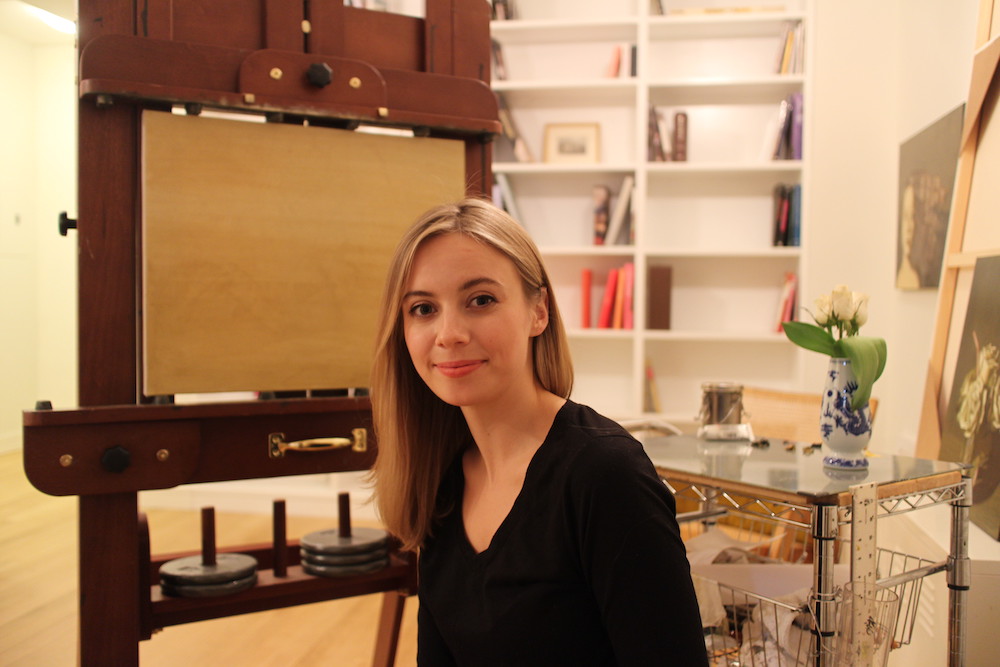
Young painters are gaining recognition faster than before. What tends to separate breakout painters from the rest? A list of names worth knowing with an in depth look at each one’s background and body of work, and answers to frequently asked questions about the contemporary painting world.
1. Anna Weyant
Born in 1995 in Calgary, Alberta, Weyant’s path into painting can be traced back to a summer art class she took in Nice, France, before entering 10th grade, where her instructor was impressed enough to write her mother a letter praising her talent, prompting her to start after school art classes back home. She earned a BFA in painting from the Rhode Island School of Design before moving to New York, where she worked as a studio assistant to artist Cynthia Talmadge while building her own practice out of her Upper West Side apartment, which doubled as her studio.
Her figurative paintings draw on Dutch Golden Age masters like Frans Hals and Judith Leyster alongside twentieth century influences such as Balthus and contemporaries like Jennifer Packer, depicting young women in tragicomic, psychologically tense scenes that critics have described as capturing “low-stakes trauma.”
Her work first drew wider attention after critic Jerry Saltz began posting it to Instagram in 2019; by 2022 she had become the youngest artist represented by Gagosian Gallery, and her painting Falling Woman set her auction record at $1.6 million that same year, up from an initial sale price of around $400 at a beachside art market just a few years earlier. Her swift rise, and her personal relationship with gallery founder Larry Gagosian, have both drawn scrutiny from critics who’ve questioned whether her prices reflect lasting merit or the market’s appetite for a compelling story.
2. Slawn
Born Olaolu Akeredolu-Ale in Lagos, Nigeria, on October 24, 2000, Slawn’s path into art began not in a studio but at Wafflesncream, Nigeria’s first skate shop, where he met close friends Leo and Onyedi and together founded the streetwear label Motherlan, which grew popular across the country and was later recognized by the late fashion icon Virgil Abloh. After relocating to London in 2018 and enrolling at Middlesex University in 2019 to study graphic design, he began painting during the 2020 COVID-19 lockdown, at first simply handing his work out for free at parties and building an online following before the art establishment took any notice.
He’s described a strikingly detached view of his own success, once remarking in an interview that he didn’t understand why people wanted his work and wouldn’t buy it himself. His 2021 debut show at London’s Truman Brewery led to a 2022 auction debut at Sotheby’s “Contemporary Curated” sale, and he’s since collaborated with luxury brands including Louis Vuitton, Rolex, Nike, and Ferrari. In 2023 he became the youngest and first Nigerian born artist to design the Britannia statuette for the Brit Awards, followed by the 2024 FA Cup Trophy and a collaboration that put his artwork on a Formula 1 car at the British Grand Prix.
3. Yuan Fang
Born in Shenzhen, China, in 1996, Fang moved to New York at 18 to study at the School of Visual Arts, later earning her MFA there in 2022 under artists including James Siena and Marilyn Minter, despite her parents’ initial disapproval of her choice to pursue art as a career rather than a more conventional path. Working quickly in acrylic, she’s developed a gestural language of curving, energetic shapes across bodies of work including Seeding, in which outlines act as the soil color fields bloom from, Battleground, where spiraling forms erupt and collide, and Setting Off, a more contemplative interlude between growth and destruction, themes she connects to her own experience of displacement growing up in southern China before relocating permanently to New York.
She’s described Jackson Pollock and Lee Krasner as her early “painting parents,” though she’s since said she’s entered a stage of her practice focused on developing her own visual language rather than looking outward to other artists for guidance. Her work has been exhibited at the Hive Center for Contemporary Art in Beijing and Latitude Gallery in New York, as well as at major fairs including Art Basel and Frieze, steadily building recognition from institutional curators.
4. Nour Jaouda
Born in 1997 with roots in Libya, Jaouda now lives and works between London and Cairo. She earned her BFA at the Ruskin School of Art, Oxford University, in 2018, followed by an MA in painting from the Royal College of Art in 2021, where she was the inaugural winner of the Emery Prize and a finalist for the Hopper Prize. Her interdisciplinary practice moves between painting, sculpture, and large scale dyed textile works shaped like the prayer mats from her surroundings in Cairo, incorporating hand crafted and found steel elements.
She sources fabric from markets near both of her homes, then deconstructs and dyes it with vegetal dyes before stitching it into pieces she calls “landscapes of memory.” Her work draws directly on her childhood in Libya, her grandmother’s fig trees, and the poetry of Mahmoud Darwish, exploring displacement and the fluidity of cultural identity. In 2024, her piece Dust That Never Settles was acquired by The Hepworth Wakefield, and her work was selected for the Foreigners Everywhere exhibition at the 60th Venice Biennale, both major markers of her rapidly growing institutional recognition.
5. Olivia van Kuiken
Gained attention at just 26 for a series of paintings inspired by a cult 1968 novella, an approach that shows how literary and narrative sources continue to shape how a new generation of figurative painters builds meaning into their work, translating text based influence into a visual, painted language rather than illustrating a story literally. Her inclusion in Cultured Magazine’s closely watched annual “Young Artists” list, alongside other emerging names working across painting, sculpture, and photography, helped cement her as one of the names collectors and curators are tracking most closely from her generation.
6. Emil Urbanek
Born in 2000 in Berlin, where he still lives and works, Urbanek creates distinct, alluring paintings with a powerful visual presence that has made him one of the standout names among painters profiled for work made by artists born in the 2000s. He’s part of a wave of young painters whose work has been described as processing a turbulent cultural moment, shaped by political upheaval, the COVID-19 pandemic, and worsening climate anxiety, through surreal and health/">emotionally intense imagery that often reimagines the human body in unsettling or exaggerated forms.
7. Amy Hui
A young Chinese painter based in the UK who recently completed her MA in painting at the Royal College of Art. Her visceral paintings incorporate home made felt materials rather than conventional canvas or paint alone, physically subverting traditional painting techniques in a way that mirrors the emotional subject matter of her work, which explores themes of fragility, self healing, and repair, often drawn from her own experience of living and working far from home.
8. Celine Ali
Part of a new generation of figurative painters whose work meets the viewer head-on, with subjects who occupy space confidently rather than passively, refusing the more traditional, submissive poses often associated with painted depictions of women throughout art history.
Her paintings are frequently discussed as part of a broader movement exploring the contemporary female gaze, using directness of composition, unflinching eye contact, and assertive body language to challenge how women have conventionally been rendered in painting.
9. Zhou Song
A painter whose intellectually rigorous, hard to categorize work explores fragmented faces and dissolving bodies caught between organic presence and something more artificial, as though his subjects are captured mid-transition between one state of being and another.
His first UK solo exhibition, staged at Maddox Gallery in the spring, marked a significant next step in a career already drawing attention from major galleries for work that resists being placed neatly within a single art historical tradition, blending figuration with more abstract, almost digital feeling distortion.
10. Eddie Martinez
A Brooklyn-based painter and sculptor known for aggressive, contrasting mixed media paintings that combine markers, spray paint, and oil paint applied in a deliberately muscular, forceful manner that critics have described as having a certain “muscular type” of strength.
His surreal abstract paintings and found-object sculptures draw heavily on urban culture and the influence of modern masters, blending street level immediacy with more traditional painterly technique, and he has become one of the most established names among the broader generation of younger American painters working today.
11. Josh Smith
A New York based painter whose wide ranging practice spans collage, sculpture, prints, and ceramics, alongside the paintings he’s best known for, canvases built around the letters of his own name, repeated and reworked as their own subject matter to interrogate ideas of authorship and originality.
By deliberately stripping his work of conventional representational or abstract subject matter, and by drawing repeated historical references to earlier art movements, Smith uses painting itself, rather than any external image, to question what a painting is even supposed to depict or communicate.
12. Chiderah Bosah
One of a wave of painters born in the 2000s profiled for work that draws directly on friends and family as subjects, using intimate, personal relationships as the emotional core of her paintings rather than broader political or historical subject matter.
Her work fits within a wider pattern among younger painters of processing anxiety, instability, and a search for stability through close, relationship driven imagery, at a moment many of her peers describe as one of ongoing political upheaval and uncertainty.
13. Josh Smith
A New York based painter, though most associated with the city’s contemporary scene, whose practice spans collage, sculpture, prints, and ceramics, alongside the paintings he’s best known for, canvases built around the letters of his own name, used to interrogate ideas of authorship and originality.
By stripping his work of conventional representational or abstract subject matter, Smith uses painting itself, and repeated historical references to earlier art movements, to question what a painting is even supposed to depict.
14. Chiderah Bosah
One of a wave of painters born in the 2000s profiled for work that draws on friends and family as subjects, using intimate, personal relationships as the emotional core of her paintings. Her work fits within a broader pattern among younger painters of processing anxiety and instability through close, relationship driven imagery rather than broad political statements.
This list changes regularly, since new exhibitions, art fair debuts, and auction results continually shift who’s considered the most exciting young painter at any given moment.
How Young Painters Build Lasting Careers
Gaining early attention is only the first step for a young painter. Many rely on a combination of strategies to sustain momentum:
- Securing consistent gallery representation rather than relying on one off sales or social media alone.
- Participating in major art fairs to gain visibility among collectors, curators, and institutions.
- Building a cohesive body of work around a recognizable theme or style, rather than jumping between unrelated ideas.
- Balancing commercial demand with continued artistic experimentation to avoid creative stagnation.
Common Myths About Young Painters
Myth: Auction success means an artist has “made it.” High auction prices can reflect short term market speculation as much as lasting critical or institutional recognition, and prices can fluctuate significantly for young artists; even Anna Weyant’s rapid rise drew criticism from some critics who questioned whether the pace of her ascent was sustainable.
Myth: You need formal art school training to become a recognized painter. While painters like Anna Weyant and Amy Hui came up through formal programs like RISD and the Royal College of Art, others, like Slawn, picked up painting later in life with no formal training and still achieved major institutional recognition.
Myth: Social media alone can build a painting career. Online visibility helps, and it played a real role for painters like Anna Weyant, whose work first spread through Instagram, but gallery representation, fair placements, and curator relationships still play a major role in a painter’s long term trajectory.
Young Painters vs. Established Painters
Young painters are often still developing a signature style and building their exhibition history, meaning their market value can be more volatile and closely tied to current trends or a single high-profile sale. Established painters typically have decades-long bodies of work, museum retrospectives, and more stable, well documented market histories. Emerging painters also tend to gain visibility through younger artist focused platforms and fairs, while established painters are more likely to be represented through major galleries and museum collections built over time.
Frequently Asked Questions
How Do Young Painters Typically Get Discovered?
Common paths include art school exhibitions, gallery submissions, inclusion in curated “young artists” lists, and increasingly, social media platforms where collectors and curators can discover new work directly, as happened early on with Anna Weyant.
What Makes a Young Painter’s Work Valuable?
Value is typically driven by a combination of critical recognition, gallery representation, auction history, and demand from collectors, rather than any single factor alone.
Do Young Painters Usually Specialize in One Style?
Many develop a consistent visual language or theme early in their careers, since a recognizable style tends to help build critical and market recognition, though some intentionally work across multiple styles or mediums, as Nour Jaouda does.
Are Young Painters Represented by Major Galleries?
Some are, especially once they gain critical attention; Anna Weyant, for example, became the youngest artist represented by Gagosian Gallery in 2022. Others start by exhibiting independently or through smaller galleries before securing representation from more established institutions.
Where Can I Find and Follow Emerging Young Painters?
Publications like Artsy and Cultured run regular features on emerging painters, and major art fairs like Art Basel and Frieze are also reliable places to discover new talent.
Leave a Comment