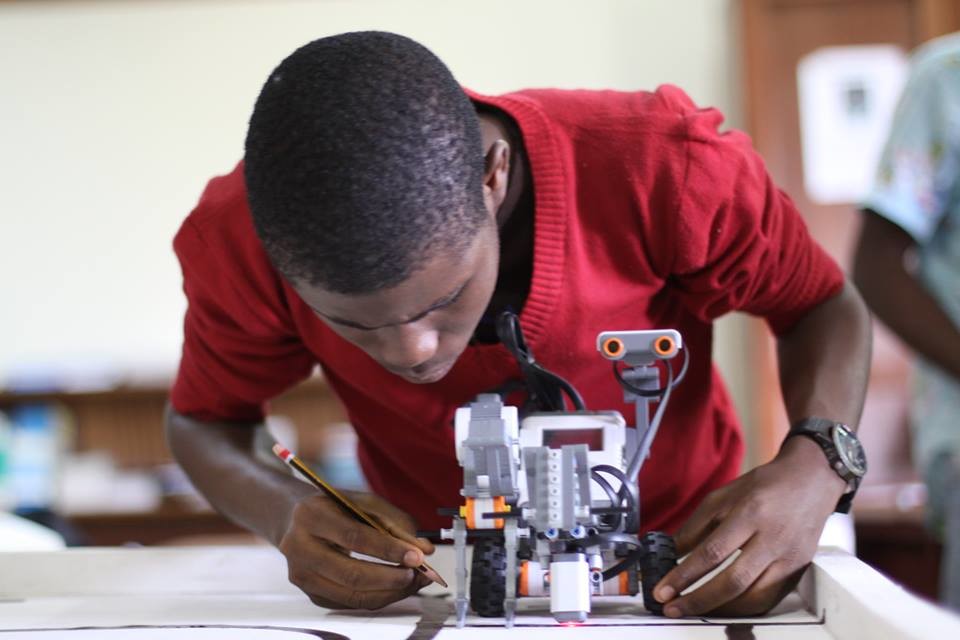
A Nigerian student studying Robotics Engineering at Academic City University in Ghana, Ikechukwu Alfred, has developed a precision agriculture system aimed at helping farmers monitor extensive farmland remotely and make more informed decisions about crop management.
Also read: Developing leadership skills in high school
The innovation combines robotics and agricultural technology to tackle some of the difficulties farmers encounter when managing large plantations. Rather than depending entirely on conventional field inspections, the system is designed to provide farmers with technology-assisted monitoring that can make the observation of crops more efficient.
Alfred’s project reflects the growing intersection between engineering and agriculture, as young innovators increasingly turn technological expertise towards practical challenges affecting food production across Africa.
The system is particularly significant in an agricultural environment where farmers may have to oversee large areas of farmland, making regular physical inspection demanding and time-consuming. By introducing automated and remote-monitoring capabilities, the project seeks to give farmers a clearer picture of conditions across their fields.
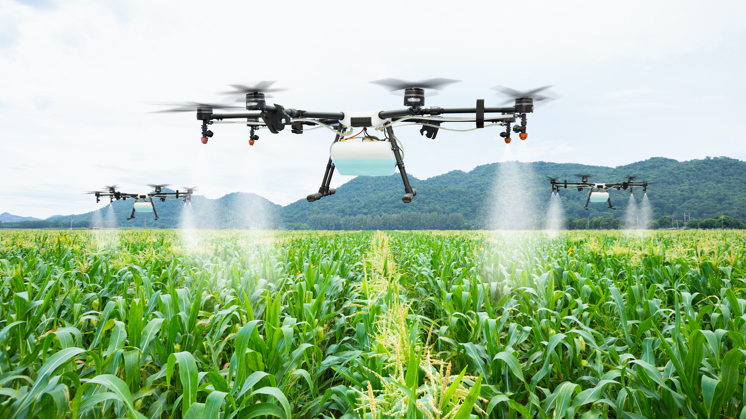
Academic City University has also highlighted student innovation in agricultural robotics. One of its students recently developed an AI-enabled drone designed to identify Fall Armyworm and support precision spraying in maize farms, demonstrating the institution’s growing emphasis on applying engineering to real-world agricultural problems.
The emergence of projects such as Alfred’s points to a broader shift in African agriculture, where robotics, artificial intelligence, drones and data-driven systems are gradually being explored as tools for improving productivity and resource management.
For Nigeria and other African countries grappling with food-security pressures, such innovations could prove valuable if they can eventually be adapted for local farming conditions and made accessible to farmers beyond research and university environments.
Alfred’s achievement therefore goes beyond an academic project. It offers another glimpse of how African students are harnessing advanced engineering skills to devise home-grown responses to longstanding agricultural challenges.
As precision agriculture continues to gain traction, innovations developed by young engineers could help usher farming towards a more technology-driven future—one where farmers can monitor their fields more intelligently, identify emerging problems earlier and make decisions based on timely information.
The development also underscores the importance of universities as incubators for practical innovation, particularly when students are encouraged to move beyond theoretical learning and apply their expertise to challenges confronting communities and industries.
Leave a Comment