By Dalhatu Liman
Stakeholders have called on Nigerian students to acquire digital and emerging technology skills to stay relevant in the future job market, warning that academic certificates alone may no longer guarantee employment.
Also read: Empowering girls key to global development — UNICEF
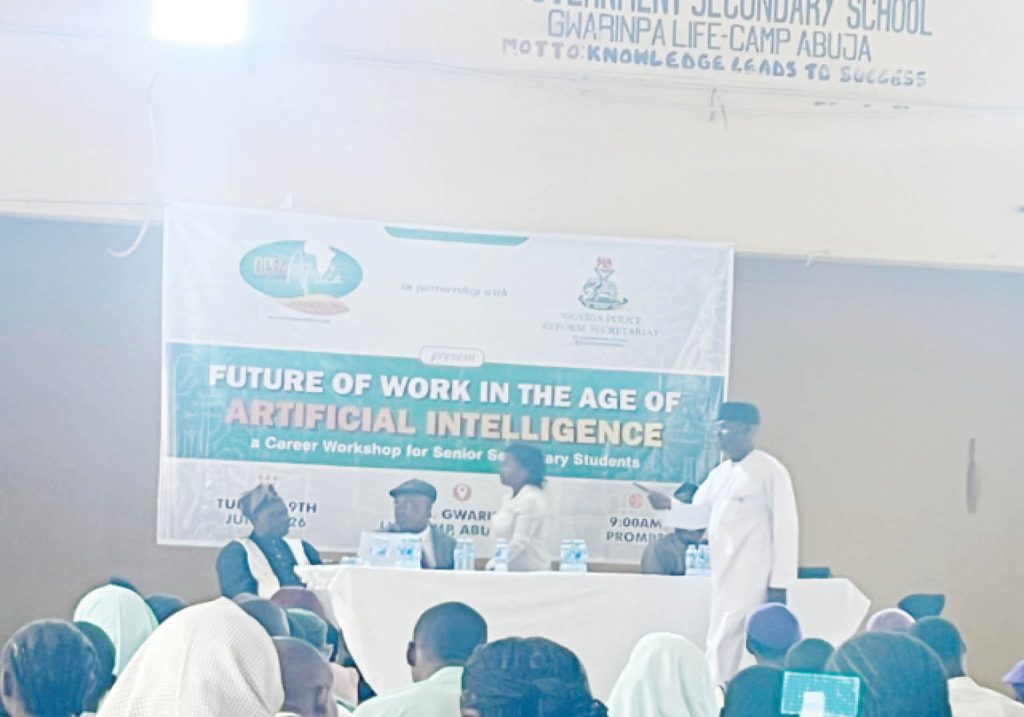
The call was made at the maiden edition of the Career Guidance and Skills Acquisition Workshop, organised by the Open Africa Foundation in collaboration with the Nigeria Police Force at Government Secondary School, Gwarinpa, Abuja.
Speaking at the event themed “The Future of Work in the Age of Artificial Intelligence (AI): Empowering Young Minds, Shaping the Future”, the Chairman of the Open Africa Foundation, Tunji Aworinde, said the initiative was designed to bridge the gap between formal education and employability.
He noted that many young people complete school without gaining practical skills needed to secure jobs or create their own opportunities.
“Many went through the education system with only certificates and not skills for employment or entrepreneurship. As we speak, youth unemployment is about 30–40% in Nigeria,” he said.
Aworinde also raised concern about what he described as “mental poverty” among some young people, urging students to develop a stronger, more practical mindset toward success.
He explained that the workshop was designed to help students begin thinking about their future careers early, before entering tertiary institutions.
“We are trying to build a mindset in these children that you don’t have to go through school and end up jobless,” he added.
Also speaking, retired Assistant Inspector-General of Police and Deputy Coordinator of the Nigeria Police Reform Secretariat, Stanley Ude, warned that artificial intelligence has also created new forms of crime, including cyber fraud, deepfakes, and fake news.
The workshop introduced students to career opportunities in AI, cybersecurity, engineering, solar installation, and video editing.
Some students also shared how the programme shaped their thinking about future careers.
A science student, Muhammad Suleyman Ali Amin, said he hopes to become a professional footballer, although he admitted the workshop broadened his perspective.
“Even if I don’t make it in sports, what I’ve learnt here will still help me in the future,” he said.
Another student, Abdulmajid Komolafe, said he remains committed to becoming a lawyer but appreciated learning about AI and engineering.
Similarly, Ewehime Onome Zita of Graceland School, Abuja, said she hopes to become a corporate lawyer and noted that AI has already become a useful learning tool in her studies.
Another participant, Treasure Ubutse Adeze, said she wants to become a radiologist and was excited to learn how technology is transforming healthcare.
The workshop brought together students from 20 public and private secondary schools across the FCT, exposing them to practical skills and emerging career opportunities in the digital age.
Leave a Comment